
jClamp for Windows (v. 23.1.0)
is a user-friendly
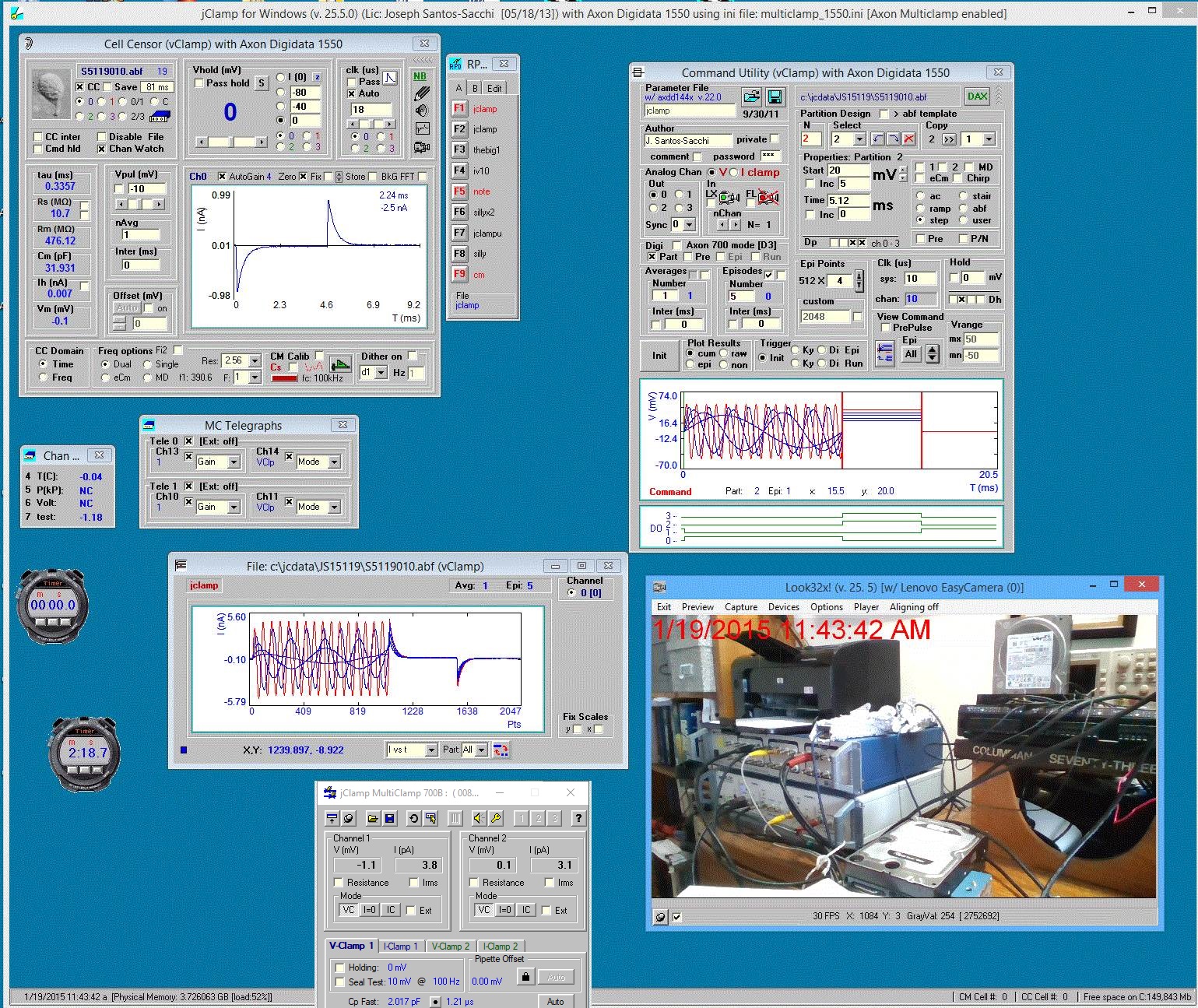
whole-cell voltage clamp data acquisition program which features real time
monitoring of cell and voltage clamp characteristics. At all times the patch
clamper can determine cell status. Data collection is initiated through a rapid
parameter directory (RPD) which maintains a list of 18 parameter filenames or
script filenames. Either a key press or mouse click begins the predefined
voltage or current delivery protocols. Scripts are text files which allow
groups of parameter files to be called and run. Most tasks are automated. Some
data analysis is available. In addition, automation links with MATLAB, Excel,
SigmaPlot and Origin are available.
-
jClamp32 - $1,500 for
educational institutions. Contact me for non-ed costs. As always, free updates.
Please cite jClamp in your published manuscripts.
Attention
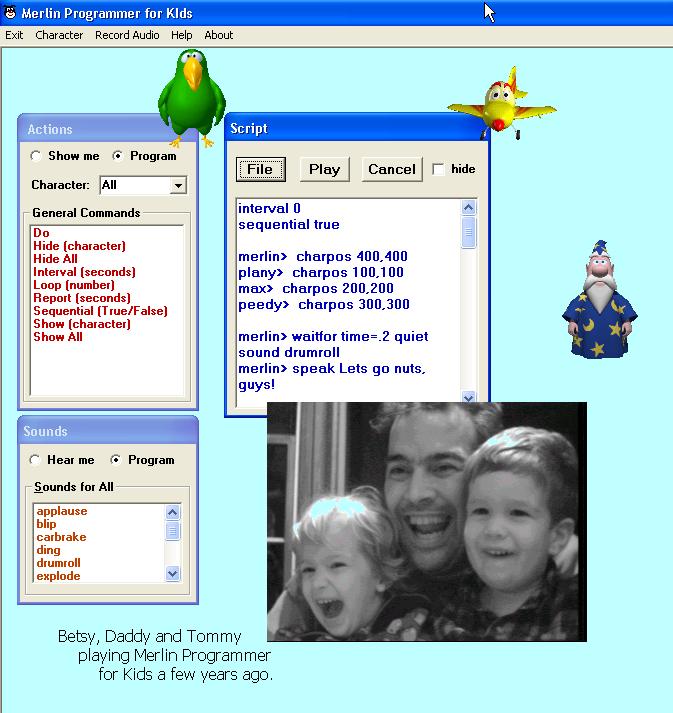
parents! Get Merlin Programmer
for Kids, an absolutely FREE fun program I wrote to help my kids (now 16)
and yours (ages 5-8) learn how to program within Windows (should work even in
Win7) and hopefully (ultimately) help support their higher education, but more
importantly help them to think logically!

· jClamp is now FREE to use with the Axon 1200A & 1200B
and the old Labmaster DMA!!! See supported hardware for more information Email
me so I can keep track of users. 
· Nanion Port-o-Patch support is here!
· You can see supported hardware info (here).
· You can see the detrending for CM analysis technical note
(here).
New Feature Update
· Full
installation to use 7Zip compression for quickie updates. Bugs fixed as well.
· Updated
MD in-cell stray capacitance compensation with software assistance, including
automatic compensation – see Cm Analysis in Help file.
· Digital
trigger now has minimal delay between triggering and data collection, except
for protocols with P/N, prepulse or CC inter use.
· Cs
stray capacitance compensation prior to cell pop-in disabled. Replaced by
robust in-cell stray capacitance compensation using MD (multi-dual) sinusoidal
stimulation (see help file).
· Molecular
Devices releases new Axoscope (pClamp) 10.3.1.4 with new DLL to fix spurious
voltage output, and allow digital output during 4 DAC output. jClamp v22.7.0 and
above uses this fix.
·
Support for the
Tecella Pico USB patch clamp amplifier (www.tecella.com). Up to four units
running simultaneously.
· Support for 4 DAC outputs for those boards that have four DACS,
including the Axon DigiData 1440A, IOTech Personal Daq, and soon the CED Power.
· The previous full version was the last one that supports
only 2 DAC channels. Future versions (coming soon) will support 4 DAC
outputs for those boards that have four DACS, including the Axon DigiData
1440A, IOTech Personal Daq, and CED Power.
· jClamp will now automatically startup with the last ini
file selected in the Identity window. An edited shortcut will override last selection
if different. Remember, to make an edited shortcut linking directly to your ini
file, edit a newly created shortcut Target property by placing your ini file
(e.g., my_ini_file.ini) at the end of the target command with a space in
between the two. To access the properties of a desktop shortcut, right click
and select properties.
· Support for both Axon Multiclamp 700A and 700B
telegraphs. Previous version only supported the 700B. See the jClamp help file
under Telegraph.
· Support for new board, NI USB X Series. Amazing! 1 megaHz 16 bit
sampling on all 8 channels without multiplexing. Synchronous digital
output. About $3K. Could not ask for more. The new NI-DAQmx 9.3
drivers need to be installed. Visit NI at http://joule.ni.com/nidu/cds/view/p/id/2337/lang/en.
·
User info (License owner,
board, operating system, disk size and memory) collected when check for updates
occurs. Useful for me to identify user issues and aid in debugging.
·
Automatic or manual check
for new version of jClamp on the web – set choice in ini file under Script Tab.
·
Impedance analysis with
Nyquist/Bode Plots and model fitting
·
Additional script commands
to control CC window parameters
jClamp Features
·
Vista and Win7 users must
disable User Control Account in Users Dialogue!
·
In-cell
stray capacitance compensation for Cm measures.
·
Digital
flip-flop overrides partition digital out in command protocol.
·
Look32X!
video capture with cameras and devices with DirectShow or VFW drivers.
Synchronized video capture with electrophysiological data (as best as Windows
will allow! TIFF and other image file support.).
·
FastLook!
-- Andor (www.andor.com) camera support and
Prosilica Gige (www.prosilica.com)
vision camera support. Link video frame capture to patch clamp data collection.
Synchronized data for each frame. Export automatically to ImageJ for video
analysis. Combined with jClamp or standalone program available.
·
CellSeeker
and MagicSeal coming soon!
·
Automatic
offset current cancellation
·
User
control over audio feedback during seal formation.
·
Enhanced
P/N subtraction.
·
·
Switch
polarity for whole cell or inverted patch in CC window.
·
Disable
dual patch mode in CC for stimulation with channel 0 or 1 D/A while recording
from channel 0
·
·
Removal of
stray capacitance effects on calibration and during cell recording for Cm
analysis
·
Plots of
Real and Imaginary components of raw currents
·
Simple way
to set angle of dRs/dY-90 or angle of dC/dY in Phase detector Admitance Window,
and angle will be used by single sine protocol to get Magnitude at 0 and 90
degree phase for C and R analysis. Note that using Rs compensation (or an Rs
dither) and C compensation (or a C dither) for dithering is a poor method for
dithering actual Rm and Cm if Rm is not much greater than Rs, or if Rm or Cm
changes substantially during your experimental measurements -- the limitations
of single sine analysis
·
Non-harmoninc
two sine stimuli to avoid nonlinear distortion interference with Cm measures.
·
Free
support for the Axon 1200A and B boards that Axon no longer supports with their
new software! See supported hardware for more information.
·
Support
for the IOtech PersonalDaq. It is a great board (~ $1,400) with many
capabilities, close to the Axon 1440 series.
·
·
Detached
Telegraph window with only the enabled channels (from 1-4 for each of the two
supported amplifiers) displayed.
·
Vista and Win7 support
·
Detached
PDF Help file in addtion to Windows Help file. You can search and print out the
help file.
·
Separate
Audio program (jc_audio.exe) for recording/playing MS wav audio files,
which can be played during script execution now, since Windows Vista
does not include one.
·
Multiple
instances of jClamp can be run, each controlling a different A/D D/A board! Or
use another instance to analyze data while the first instance is actively
collecting data.
·
Frequency
analysis can successfully monitor bilayer prep capacitance, making jClamp a
good choice for these types of studies
·
Cell Censor
window provides full cell parameter analysis either in Time or Frequency domain
·
·
Axon Multiclamp
telegraph support.
·
User selectable
channel input for telegraphs.
·
Real time,
scalable plotting of Cm or Im vs time or voltage collected with protocols.
·
Support for Axon
1440 series!
·
Support for
National Instruments M series boards. NI 6251-USB and NI PCI-6221, in
particular.
·
NI boards that use
Ni-daqmx driver (M series and also the PCI-6052E) and Axon's 1320 and 1440
series now can have dual analog output and up to 8 input channels.
·
The NI PCI-6221
board is used by Neobiosystems to control their ( PatchMAX 100A ) and
jClamp will work with their system to provide user friendly patch clamp and two
electrode voltage clamp solutions.
·
User choice of
Dual frequency Cm calulation from f1, f2, or aveage of both.
·
Phase Sensitive
Detector (PSD) exposed for phase analysis.
·
Automatic fusion
event analysis.
·
Easy capacitance
measures – new method based on actual angle of dY/dCm – perfect at last!!.
·
Average after all
episodes are run or average each episode before continuing to the next
episode..
·
Smart averaging –
only average as many runs as required to reach a desired signal to noise
ratio!.
·
More flexible
delivery of frequency stimuli.
·
Axon 1322A
support.
·
Storage view in
Analysis mode – view two data file plots simultaneously (previously opened and
current) .
·
Independent
analysis and data collection CM calibrations file loading.
·
Streamlined
generation of command protocols from ABF data files .
·
User choice of
detrending of raw data prior to CM analysis (Technical Note released) .
·
NI PCI-MIO-16E-1,
NI PCI-MIO-16E-4 support.
·
Fitting with user
supplied equations.
·
Now measure
capacitance with either 2-Sine analysis or Phase tracking.
·
Very detailed
information for all files in data directory in data load window when info
button is pressed.
·
IV plot window
calculates reversal potential, and slope resistance; multiple I-v plots for
comparison.
·
Quick notes window
allows button click insertion of pre assembled, often used notes into the log
file.
·
Conditional
scripting with parameters from Cell Censor. For example, wait for membrane
resistance to reach a certain value before running a protocol.
·
DCM files are only
saved when enabled in ini file under History tab.
· CED Power 1401 support. Four DAC outputs;
control four patch clamp amplifiers. Channel watch channels moved from 2-5 to
4-7 for all boards. Shell out (from Data Load window) to Adobe Acrobat or
reader to look at lab notebooks. I suggest that you scan in your hand written
notebooks as an image and place a PDF conversion into each day's data directory
for viewing. NT and 2000 support for Labmaster DMA and Daqp 308 boards. jClamp
for the old Labmaster DMA board is FREE!!! No license needed. Great for student
labs!!!! Break out those old boards and put them in some new, fast and cheap
computers.
· jClamp for the Labmaster DMA is free --
no license required. Remember the free license is only available when the ini
file is set to use the Labmaster board or axdd1200 board (under gain tab). Set
the proper address for the Labmaster! The Labmaster board is controlled
exclusively through Port I/O witht the jClamp VXD or SYS driver. The only
differences with the hardware setup required by pClamp is that the ports A0-A7
should all be configured for output. A7 is scope trigger. See the hardware
manusal. B0 is trigger input. C channels are not used. 2-sine protocols are
supported. Win 2000/XP Pro performance is superior. The Axon 1200 board needs
the DriverLinx installation (NT version for Win2000 and above). Axon supplies
the drivers. Email me if you have a problem getting them. Axoscope 9.0.2.05
supports the board, so you must use that program to verify that everything is
working before using jClamp. Normally, if there is no hardware license the
registration window will appear, indicating that the license is software only
or that so many days are left in the hardware fulldemo license. For the free
labmaster or Axon 1220 support, there is no license, so the register window
will open. If you want to bypass that window you may create a shortcut on the
Windows desktop to jclamp32.exe, as you would do for any other program. The
shortcut made during jClamp installation cannot be edited, you need to create
an editable one by going to the jClamp directory and right ckick over the
jClamp32.exe file and send shortcut to the desktop. Then you can edit the new
shortcut. In the properties window, target line, you should append the word
"skip_reg". For example, <"C:\Program
Files\jclamp32\JCLAMP32.EXE" skip_reg> is taken from the target line of
a shortcut. It will run jclamp but not display the registration window. You
could also specify a particular ini file other than the default jclamp32.ini by
doing the following. <"C:\Program Files\jclamp32\JCLAMP32.EXE"
my_ini_file.ini skip_reg>. Note there is a space after the executable name
and between the ini filename and "skip_reg".
· Multiple stopwatches.
· Streaming video capture and playback;
record video during data collections; control through script or via Look! video
window. Screen shots available from scripts.
· CM calibration changed to provide more
resolutions. accalib.prm and accalibi.prm are revised. Please
recalibrate to use extra resolutions. Remember to check proper function with
electrical model!!!!!
· Channel watch is functional (if enabled)
even when CC is not running.
· Conditional scripting. Continue scripting
after switch from/to current/voltage mode or based on values obtained from
analog Channel Watch (e.g. based on temperature change reading).
· Ability to transfer voltage clamp holding
current to current clamp upon mode switch. Also, current clamp membrane
potential to voltage clamp.
· Ability to set all partition start
voltages/currents to holding level in Command Build Utility. Useful when
passing hold from Cell Censor to protocol.
· Better memory management in Win 98.
IniEditor can now be opened from within jClamp without "out of
memory" error. Tested with 128 Meg memory system.
· Automation link with SigmaPlot 2000,
Excel 9, MATLAB 5.3 and Origin 6. Rapid data transfer and plot generation. May
work with some earlier versions. Enable use for each program seperately in
jclamp ini file. Scripting of application commands in jClamp analysis scripts.
· Two sine FFT based CM tracking now
supported under current clamp.
· Ability to use data file (abf) traces as
commands in Command Build utility. Automatic generation of command parameter
files from abf data files. For example, immediately stimulate cells in current
clamp with currents obtained under voltage clamp. Also, FFT can now be computed
on any portion of data trace with automatic zero padding.
· Support for the National Instruments
PCI-MIO-16EX-10 (10 usec) and PCI-6052E (3 usec) boards, 16 bit A/D, D/A--
boards with breakout about $2K.
· Support for the IOtech daq2000 PCI board.
16 bit A/D, D/A @ 100kHz -- board is $500! Cabling and breakout extra.
Important -- contact me before getting one (there is a glitch on analog out).
· High time and magnitude resolution
capacitance measures during episodic protocols! Measure capacitance, Rs, Rm
simultaneous with your favorite step, ramp or AC protocols. Automatic analysis.
Episode length up to 1 million pts for Axon boards and IOtech daq2000 --
measure voltage induced capacitance changes up to 10 seconds per episode (@ 10
us clock)! 10 million pts for National Instruments boards!
· Real time monitoring of cell and clamp
characteristics in Cell Censor Window. Full control over two patch clamps.
Channel 0/0 [A/D- D/A ](patch clamp #1), channel 1/1 [A/D - D/A] (patch clamp
#2), both channels or junctional coupling possible. Pseudo-simultaneous
measures under current and voltage clamp on channel 0 and 1 in Cell Censor. Automatic
pulse polarity flip-flop for charge buildup control.
· Four additional channels can sample
peripherals (e.g., pressure monitor) at user selected rates
· Works with either the DigiData 1200,
1200A or 1320 series boards from Axon Instruments, Labmaster DMA, IOtech
daq2000, National Instruments PCI-MIO-16EX-10 and PCI-6052E boards or Quatech
DAQP-308 PCMCIA -- have Lap can Clamp!

·
I suggest a Hauppauge video
capture card - you can get them without the TV tuner for less than $100.
Connect
to Hauppauge to
check out the Hauppauge WinTV PCI video boards
Connect
to NI
to check out the PCI-MIO-16XE-10 board and connection hardware
Connect
to NI
to check out the PCI-6052E board and connection hardware
Connect
to Iotech to
check out the daq2000 board and connection hardware
Connect
to Axon Instruments
to check out the 1320 series systems
Connect
to Quatech
to check out the Daq-308 PCMCIA card and connection hardware
Connect
to CED to check out the CED
Power 1401
Connect
to Scientific Solutions
to check out the new Labmaster Boards and connection hardware
·
Convert digital outputs to
analog outputs with the optional DAX (D/A eXtra) hardware add-on. Control up to
four more amplifiers. Monitor seal formation, set holding potentials, monitors
cell characteristics, synchronous episodic delivery.

·
Four channel graphical
history display of selectable cell and clamp characteristics - time window user
adjustable.
·
Graphically view seal
formation with frequency varying audio cues.
·
Customizable initialization
settings for individual users - including graphic ID in Cell Censor window.
Separate initialization file editor.
·
Automatic data directory
naming, file naming and saving.
·
Powerful graphical
voltage/current protocol build utility. Episode length up to 10 million for
National Instruments boards, 1 million pts for Axon boards and IOtech daq2000,
128k pts for Labmaster and DAQP-308. Step, ramp and AC stimuli (one, two or
three sine; chirp). Dual command protocols support simultaneous current and/or
voltage clamp. Gap free collection is supported. Full command waveform
scaleable based on user scale factor set in INI file. For example, with a
button press increase or decrease the wave form magnitude by a factor of 2
about the holding level. Additionally, toggleable timing increments by a factor
of 2. Automatic saving of individual runs during averaging.
·
Protocols can be run at the
press of a key or click of a button. External file based user stimulus
incorporation. Arbitrary number of input channels and order of input channels
in parameter files. Analog output is through channel 0 or channel 1, or both
simultaneously. Each parameter file contains information for separate and
distinct command waveforms for each output channel. Random episode delivery;
auto supplemental A/D gain (1-8X) {Axon 1200, DAQP-308 and daq2000 boards};
dual telegraph inputs to control gain and clamp type, and monitor capacitance
and filter frequency.
·
Digital output during,
before, after or synchronous (depends on board) with analog output.
·
TTL or key triggerable
starts - full run or individual episodes.
·
Text, audio and video (time
lapse grabs, or linked to data collections[after each average, or episode])
clips can be saved, and easily retrieved and played during analysis. Any
Windows compatible cards with wav audio drivers and video for Windows drivers
will work.
·
Script files can run
individual protocols or loops can be programmed; wait periods are allowed
between protocols and during these periods cell and clamp characteristics are
continuously monitored and saved to disk. Control holding potentials (main
board and DAX); output serial port commands, e.g. to control external hardware
[GPIB under construction]; set digital out ports; trigger video capture or time
lapse capture.
·
Scripts can be automatically
canceled if one or more particular cell or clamp characteristic crosses a
predefined threshold; e.g., if resting membrane resistance (Rm) drops below 50
Mohm or if electrode resistance rises higher than 40 Mohm.
·
Analysis features are smooth
and graphical. Axes or scale bars. User text on plot. Episode math, file math,
fitting of exponentials, Boltzmanns, FFT. Residual series resistance
correction, cursor based analysis, IV plots, togglable leakage subtraction
(view raw or subtracted traces), x-axis data shifts. Exporting of data to abf,
atf, ascii, or matlab. Copy plots to clipboard for paste in word processors.
Trace comparator - combine traces from Analysis window into new window for
comparison across files.
·
Data file loading is
enhanced by the ability to view key items in the file before loading; e.g. data
owner, cell and clamp characteristics immediately prior to data collection,
parameter file name, sampling clock, number of channels etc.
·
All data collected can be
summarized in printed form. Each protocol and associated data traces are
printed along with key protocol parameter information - four data files per
page. All cell and clamp characteristics for each cell studied are plotted
versus time.
·
Data files can be selected
by parameter filename and printed or plotted on screen (plots have selectable
interplot periods and a pause feature).
·
Each data file has appended
the parameter file in ASCII format, allowing the display of all information in
the build utility during data loading. Key ASCII information can be searched
for and files save to a new directory for group analysis.
·
Logging implemented. Recall
and play (abf, cc, cm, not [audio, video, text, cc clip] ) files from log
window with button click. Search logs for information. Show all logs on disk.
Edit them. Log is run from Main menu bar in jClamp (when in Analysis mode), or
can be run as an independent program (jc_log.exe).
·
Capacitance tracking allows
monitoring of cell characteristics using two sine FFT based analysis with
analog and/or digital stimulation (prepulse, incrementing pulse, ramp) at 2.5
or 5ms resolution and noise of 10fF (model cell with 200 MHz Pentium).
Additionally, capacitance, Rs, Rm can be measured simultaneously with your
favorite step, ramp or AC protocols. Automatic analysis. Very powerful feature!
·
Analysis scripts. (under
construction)
·
Binary save of Cell Censor
and CM tracking data files. Faster save and load, and smaller size. Ability to
save in ASCII format set in INI file.
·
"Screen Shots" to
save jClamp window arrangements for instant retrieval; Collapsible Cell Censor
window. Sizable plotting window during data collection (drag to size).
Unobtrusive RPD window, updated searchable help file (including help on the new
features). Screen shots can be loaded at the command line in a shortcut --
"jClamp.exe myinifile.ini collect.scn" will bypass the Identity login
form and load the saved sreen format.
·
jClamp32 - $1,500 for
educational institutions. Contact me for non-ed costs. As always, free updates.
Please cite jClamp in your published manuscripts.
Files may be downloaded for a
trial examination.
email me for a username and password;
please include your affiliation, operating system and hardware.
I suggest a fast computer (>1GHz), at least
512 Meg memory, and fast video! jClamp is a large program. It works best in Win
NT, 2000, XP, Vista or Win7 - for those boards which can work in these
environments. Cm tracking with the Axon 1200 board has problems in Win NT if
run from Cell Censor but not within command protocols. All will work in W95/98,
however.
|
Name
|
Last Modified
|
Size
|
Description
|
|

|
jClamp
Help file
|
10-May-2008
|
1.8M
|
jClamp Help file
(jclamp32.chm); to view you may need to unblock in the security tab of the
file properties
|
|
|
|
|
|
|

|
FastLook!
Help file
|
2-Mar-2010
|
1.0M
|
FastLook! Help file
(fastlook.chm); to view you may need to unblock in the security tab of the
file properties
|
|
|
|
|
|
|

|
Supported Hardware
|
1-Jan-2008
|
5K
|
install information
|
|

|
getting_started.htm
|
1-Jan-2008
|
1K
|
Getting started and Labmaster DMA support
|
|

|
jClamp32_v23.1.0.msi
|
22-Jun-2012
|
31M
|
New 32 bit (v 23.1.0) version setup files [make sure to
check below for an updated jc_exe.exe]. The new
jClamp version will work in Windows Win7/Vista/XP/NT/2000/Me and /98. See
above for features. Per-machine license required. Software demo license
included. Time-limited hardware license see below. Read getting started.
|
|

|
jc_exe.v.23.*.*.exe
|
Whenever
|
1.1M
|
New 32 bit executable (do not use with previous versions
before the latest posted full install - look here for newer executables - the
link will be empty if no update exists). The file has a version that
indicates the version of extracted jClamp32.exe. Place in jclamp32 directory,
double-click to extract jclamp32.exe and select overwrite to replace the old
version. No need for full install if posted full version was installed.
jClamp will check automatically to see if a new version is available.
|
|

|
ax_driv.TXT
|
23-Oct-2000
|
1K
|
installed Axon driver files
|
|

|
|
|
|
|
|
fulldemo.lic
|
Monday
|
1K
|
30 day hardware license for evaluation of jClamp or
FastLook. Rename to jclamp32.lic and replace the software-only license file
in the jclamp32 directory, or rename to fastlook.lic and replace the
software-only license file in the fastlook directory.
|
|
|

|
|
|
|
|
|
detrending
|
14 Feb 2003
|
500K
|
Technical Note on detrending data before FFTing for CM
analysis. User can now choose whether to use detrending.
|
|
Connect to Axon Instruments to
download Axoscope and the Digidata drivers for Win95/98 and WinNT
Copyright © 1996-2012 J. Santos-Sacchi [SciSoft]
Last modified: Jul 22, 2012